
 Herbs
Herbs Vegetables
 Fruits
Role Of Agriculture In Kenya
Agriculture in Kenya remains an important sector despite its relatively small contribution to the gross domestic product (GDP). The sector plays an important role in terms of job creation, especially in rural areas, but is also a significant earner of foreign exchange.
Agriculture’s prominent indirect role in the economy is a result of backward and forward linkages with other sectors. Purchases of intermediate goods and services form backward linkages with the manufacturing sector, while forward linkages are established through the supply of raw materials to industry.
Approximately 70% of agricultural output is used as intermediate products. Agriculture is therefore a crucial sector and a key driver of growth for the rest of the economy – a fact also acknowledged in policy-related documents such as the National Development Plan 2030.
Essentially the Development Plan entails that agriculture – both emerging and commercial – should still be afforded the opportunity to contribute optimally to economic growth, job creation, foreign exchange earnings and development of the industrial sector within a safe and non-discriminatory environment.
Agriculture makes its contribution to economic development in several ways:-
- By providing food and raw material to non-agricultural sectors of the economy.
- By creating demand for goods produced in non-agricultural sectors, by the rural people on the strength of the purchasing power, earned by them on selling the marketable surplus.
- By providing investable surplus in the form of savings and taxes to be invested in non-agricultural sector.
- By earning valuable foreign exchange through the export of agricultural products.
- Providing employment to a vast army of both educated and uneducated personel labour. This would assist in minimizing the unemployment rate.
As a matter of fact, if the process of economic development is to be initiated and made self-sustaining, it must begin for the agricultural sector.
Greenhouse Effect
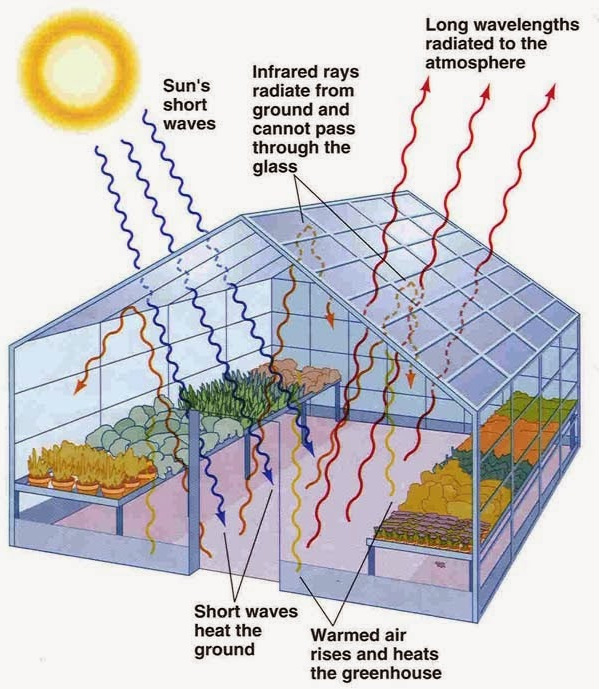
The greenhouse is an area isolated from the rest of the environment by a transparent cover that allows maximum transmission of sunlight, through which the plants' photosynthetic process takes place.
The radiation reaches the greenhouse directly from the sun and is diffused back from several reflecting celestial bodies throughout the heavens (clouds, dust etc.).
Not all the radiation that reaches the covering sheets reaches the plants. Depending on the properties of the cover material and the angle of ray's impact on the cover, some of the radiation is bounced back into the sky, and some is absorbed in the material itself.
The light that passes into the greenhouse is absorbed in the plants, the soil, and parts of the structure itself and warms them (since the energy contained in the absorbed radiation turns to heat.) The air in the greenhouse also comes in contact with the heated areas, is heated by these, and the result is an increase in the general temperature in the greenhouse.
Covering materials in greenhouses usually block long-wave radiation (light emitted from bodies having low temperatures.) Therefore, the heat that is emitted from the heated areas is absorbed in the cover, causing it, in turn, to warm as well.
This conversion of energy from radiation to heat in a covered area is commonly called "the It should be remembered that the amount of energy available to the plants inside the greenhouse depends upon many variables:
First and foremost, the amount of solar energy outside: Outside energy is affected by geographical location (latitude), time of year, time of day, celestial brightness, etc.
Outside energy, upon entering the structures, is somewhat reduced due to the physical properties of the cover, the geometrical shape of the structure and its position in relation to the north (which determines the angle between sunlight and the cover surface, in turn affecting the transmitting radiation.) Add to that the mutual shading of the structure's skeletal parts, shading from support systems that are installed above the plants and so forth (and therefore the amount of sunlight inside the structure will be lower than outside of it).
This process (the greenhouse effect) enables reaching a much higher temperature inside the greenhouse than outside of it. In a low-temperature environment (e.g. Limuru, Kenya), this will naturally be considered a positive thing. In areas where temperatures are sometimes extremely low, close to freezing point, plants in the open either die or yield nothing. In such cases, cultivating under cover is therefore crucial to achieving any produce at all.
However, when and where the outside temperature is naturally high (such as in arid areas e.g. North Eastern Kenya), the temperature inside the greenhouse will be extremely high. In order to avoid these extreme temperatures, special measures should be taken, such as ventilation, cooling, shading, etc.
In point of fact, cultivating crops in a greenhouse is far more complex. Aside from influences on the temperature, due to water vaporization from the plants, there is an increase in humidity compared to outside conditions. In this context, the increased humidity can be regarded as positive and beneficial within certain boundaries. However, if humidity rises too high and for long periods of time (when the greenhouse is closed and unventilated), there is a high probability of crop damage.
FAQs About Our Greenhouses
We’ve put together a list of answers to the most commonly asked questions from our customers.
We are 100% committed to making sure our customers have a positive and successful experience with Dazzle Farms. If you don’t find the answer to your questions in the list below, please contact us and we’ll be happy to assist you.
There are many greenhouse styles. A free-standing greenhouse stands on its own and can be located anywhere. Lean-to greenhouses are attached to the wall of a building and are easier to heat because one side is a solid wall. Regardless, greenhouse should be tall enough for you and your plants. More info.
A good greenhouse structure must handle wind, rain, and snow (where applicable), and allow for benches, shelves, hanging baskets, light fixtures and other accessories, such as heaters, coolers and fans. We have 7 years of experience behind our designs. To keep moisture from dripping on you and your plants, condensation control is handled with a smooth inside roof surface and sufficient roof pitch. Top-opening roof vents provide natural, gentle, quiet venting. Combining top vents with base wall vents and/or louvered windows, hot air exits through the roof and cooler air flows in down low, which helps preserve humidity. Roof vents could be automated. We have Sturdy-built designs so we make sure you get the best design features for your situation.
Greenhouse installation is a very specialized process, and the overall cost is dependent on the options you select. Just like anything else, your most cost effective option is to hire professionals that have the experience necessary to see your project to fruition. Budgetary numbers for new construction usually fall in the range of KES 1300 (10 USD) to KES 2000 (16 USD) per square meter for high-tech greenhouses.
Contact us and let us know what you are looking for. We will promptly generate a custom estimate tailored to your specifications.
Select a greenhouse as large as your site and budget will allow. Greenhouse gardeners inevitably wish they had more space to accommodate their growing plants. Adequate height is important for your comfort as well as providing room for shelves and hanging plants. Additional growing space can be provided with a shorter base wall that allows for more under-shelf growing space as well as shelves along the walls.
Only your local building department can tell you for sure. This is normally an agency within the city or county government. Call them and let them know the size and type of structure you are planning on building. Compliance is the responsibility of the buyer
Smaller hobby style greenhouses (under 120 square feet) typically do not require building permits. If a permit is required you also might have to provide a certified engineering drawing to the building officials before you can obtain one. If required, we can supply, for an additional charge, certified engineering prints and calculations for most of our greenhouses.
Note: It is important that this be done prior to ordering the structure. You alone are responsible to make sure that you are building in accordance with your local codes. We will do our best to help you through this process
First, explore our Greenhouse Designs, which will provide you with articles and resources to learn everything you ever wanted to know about the types of greenhouses we install, as well as all of the Greenhouse Equipment that Dazzle Farms offers. If you have taken a look at our greenhouse designs and still cannot decide which greenhouse will be best for you, Contact Us, and our experienced sales technicians will help you throughout the process.
Sturdi-built draws on our 7 years of experience to set you up with the proper equipment for your situation depending on the location and climate of the area. This usually includes:
Circulating fan: Air movement is essential for a healthy greenhouse environment and helps reduce heating costs and condensation. We recommend continuous, gentle air movement 24/7 provided by an oscillating fan.
Heater: Type and size of heater depends of the size of the greenhouse and the inside and outside temperatures involved. Gas (natural or LP, vented or non- vented) or electric (120V or 240V) heaters can be used. To make a 120V heater more effective add an additional thermostat to turn the heater on and off at specific temperatures.
Coolers: In very hot climates sometimes positive cooling is needed. Air conditioners de-humidify the greenhouse, so we recommend evaporative air coolers which draw hot air through wet pads using a fan or blower. Water evaporates from the pads, providing cool, clean, humid air.
Humidifier or mister: Plants need adequate humidity in a hot greenhouse. Generally, wetting down a porous (bricks, gravel) floor is the easiest method for creating humidity. An automatic humidifier or a misting/fogging system may be added if more humidity is desired.
Shading: Depending on sun exposure and plants being grown shading might be needed. Ways to shade include shade cloth, shading paint, roll-up shades and fiberglass panels. We recommend custom-fit shade cloth panels added to all or part of the greenhouse. Attached onto the outside of the greenhouse, they are effective, neat in appearance, reusable and available in a variety of densities.
Propagation Mats: With good bottom heat, propagation is easy and fast, even in a cool greenhouse. Propagation mats are great for supplying heat to plants in containers.
Shelves & Benches: Generally some type of benches and/or shelves are needed. Many options are available and depend on the size and style of your greenhouse.
Call us (+254 732 400 444) or email (info@dazzlefarm.com) to talk through your greenhouse gardening needs. We talk through issues such as location, covering materials, ventilation, circulation, heating, cooling, shading, etc., and share our experience and knowledge to create the greenhouse you desire. Our greenhouses are not “one size fits all”. We work with each customer to put together the best greenhouse possible. We use our years of experience working with customers all over the continent and the world (many of whom we have visited), and apply this knowledge to your situation. Let us help you with your greenhouse dreams.
Depending on the size of the greenhouse, our greenhouses are delivered via truck. If you live in a remote rural location or other area difficult for trucks to access, let us know ahead of time. We organize every shipment and we could have a third party trucking company deliver the materials to you. Usually they call you in advance to arrange a delivery time. Units delivered within Kenya are delivered directly by us.
- Long lasting – Our greenhouses will operate for many years and will be an investment you can grow into.
- Energy efficient – All of our systems have been selected based on performance and efficiency. Low operating costs ensures profitability, even in saturated markets.
- Full systems integration and automation reduces labor and maintenance cost.
- Fastest assembly on the market. Less time building means less money spent. Every component of every system arrives to the job site pre-fabricated, and only requires basic assembly.
Yes, despite any logistical challenges in the shipping and delivery of your products, we will gladly work with you directly to determine how to help you complete your greenhouse project. If you are located outside of Kenya and would like to purchase from Dazzle Farms, please contact us.
If you have any questions which are not covered above please Contact Us we are happy to answer any of your questions.